Test your website on a real Android phone.
Bezel frames your page in a Pixel, Galaxy, OnePlus or Nothing phone, and the code inside sees a real Android. Chrome’s true viewport, the phone’s exact pixel density, a touch device, and honest client hints. Not a desktop window squeezed narrow.
Pixel · Galaxy · OnePlus · Xiaomi · Nothing · Android 16 · runs 100% local
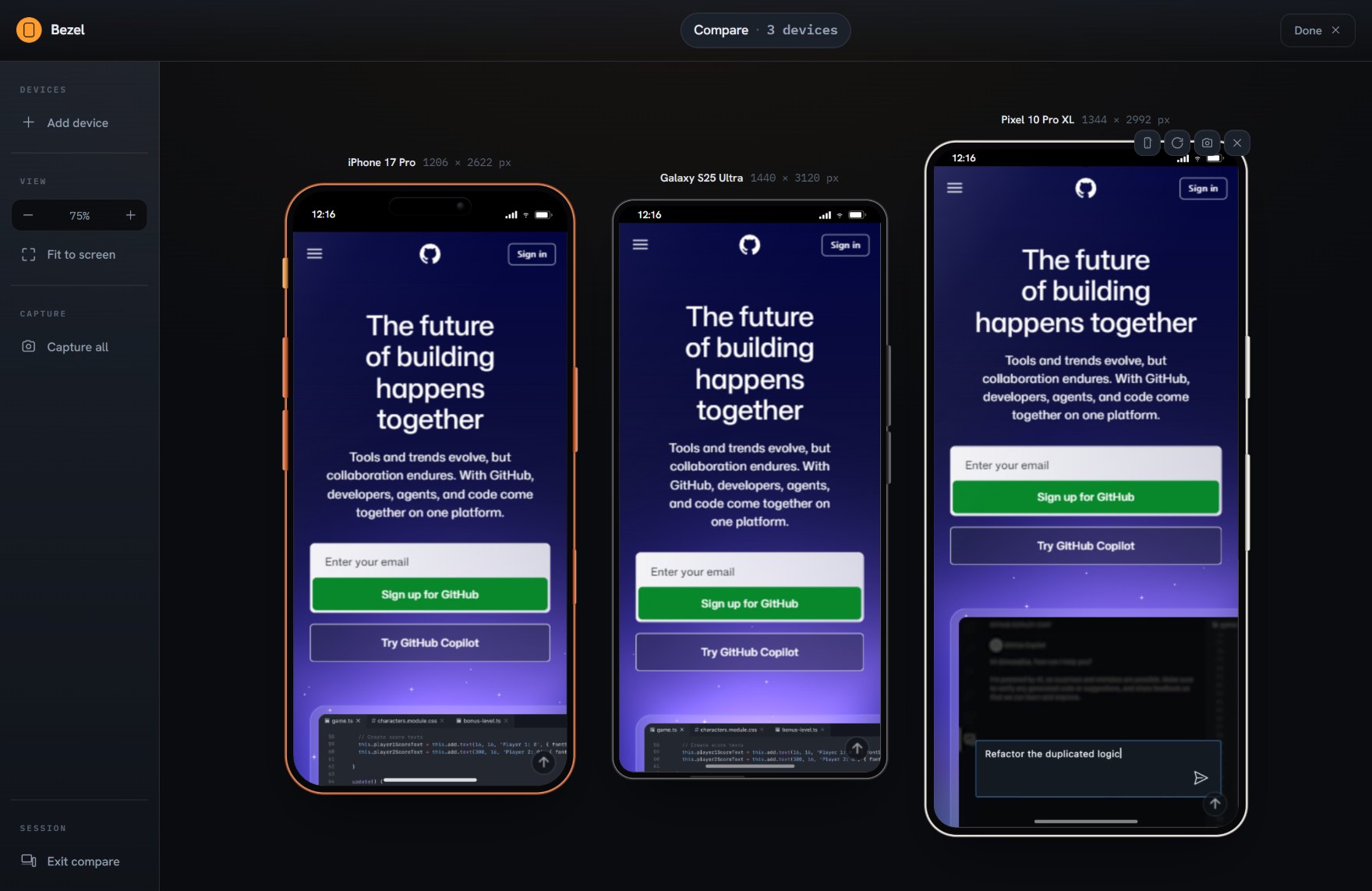
Android is where a fake phone breaks first.
Android hardware is diverse in exactly the ways a resized window ignores: fractional pixel densities, a huge range of widths, and Chrome’s own client hints. Bezel matches the real device, so your layout is right on the phone people actually hold.
- Exact pixel density, fractions included. A Pixel renders at 2.625x, a Galaxy S25 Ultra at 3.75x. Bezel renders at the real device pixel ratio, something a dragged desktop window simply cannot do, so images and hairlines land correctly.
- Real Chrome viewport. From compact 360 px phones to tall 412 px flagships, your media queries and responsive images fire at the widths real Android phones report.
- Reports as a touch device. maxTouchPoints, ontouchstart and pointer: coarse all report touch, so tap targets, touch-first layouts and hover fallbacks behave like a phone. (Bezel spoofs what the page detects, not your actual mouse input.)
- Honest User-Agent and client hints. Bezel sets the device’s User-Agent and the mobile client-hint flag and drops the desktop hints, and navigator.userAgentData reports the phone, so your stack serves the mobile bundle and the right assets.
Works with whatever you build. Bezel frames the rendered page, so it does not care how the page was made. React, Vue, a static site or plain HTML all behave the same inside a real device.
More than half of all web traffic is mobile. Most of it is checked on a desktop window.
A shelf of real test phones costs thousands and is out of date within a year. Bezel is free, runs in the browser you already have, and stays current with the latest devices — so the mobile view you sign off on is the one your visitors actually get.
38 Android phones, real specs
Pixel, Galaxy, OnePlus, Xiaomi, Nothing and more, each with its true viewport, pixel density and Android version.